


Most people meet the phrase “background check” in a hiring context. Somebody applies for a job, a screening company runs criminal records and verifies employment and education, and the whole process runs under rules written to protect job applicants.
A due diligence background check is a different instrument, pointed at a different subject, under different rules. The subject is a business and the people running it. The purpose is a commercial decision rather than a hiring one. And it sits outside the law that governs the version you already know.
If someone has just told you the company needs one before a deal closes, that difference is the thing worth understanding first.
A pre-employment check is governed by the Fair Credit Reporting Act. That framework exists to protect individuals being considered for a job, and it brings specific obligations: written consent from the subject, disclosure of what will be checked, and a formal adverse action process if the result affects the decision. It also constrains how far back a report can reach.
A due diligence background check on a business counterparty is non-FCRA work. Nobody is being considered for employment, so those rules do not apply. In practical terms that means a longer lookback, access to a broader set of records, and no requirement to obtain the subject's consent before running it.
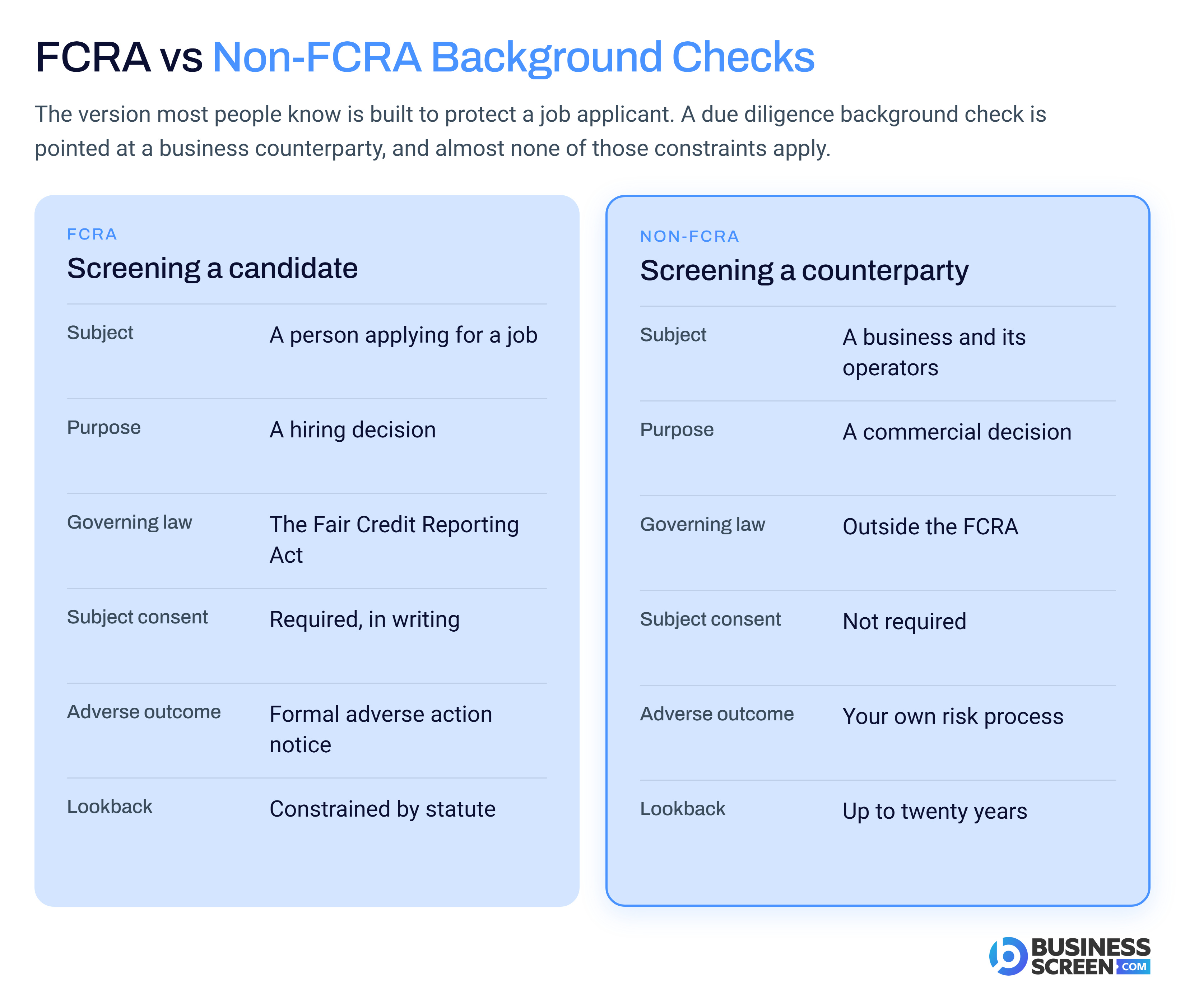
That last point surprises people whose only reference is hiring, and it is worth stating plainly rather than discovering halfway through a deal. We covered the fuller version of the distinction in background checks versus due diligence.
The most useful thing to settle before ordering anything is not which searches to run. It is this: what would you need to find out in order to rethink this deal?
For some readers the answer is a history of fraud or criminal activity in the people involved. For others it is financial strain on the business, unpaid liens or judgments that would jeopardize performance on a contract. For a lender it might be a personal guarantee that turns out to be worth less than the file suggests.
We start client relationships with that question because the answer determines the shape of the work. A check built around a specific set of deal-breakers returns something you can act on. A check ordered because it seemed prudent returns records nobody knows what to do with.
The reasonable follow-up is whether any of this is likely to find anything.
Across the due diligence background checks we run, about one in four companies turns up an adverse record: a lien, a judgment, a civil suit, a bankruptcy, a sanctions match or a regulatory action. For the individuals behind those companies it is closer to one in eight. Both figures come from our own completed reports rather than an industry survey.
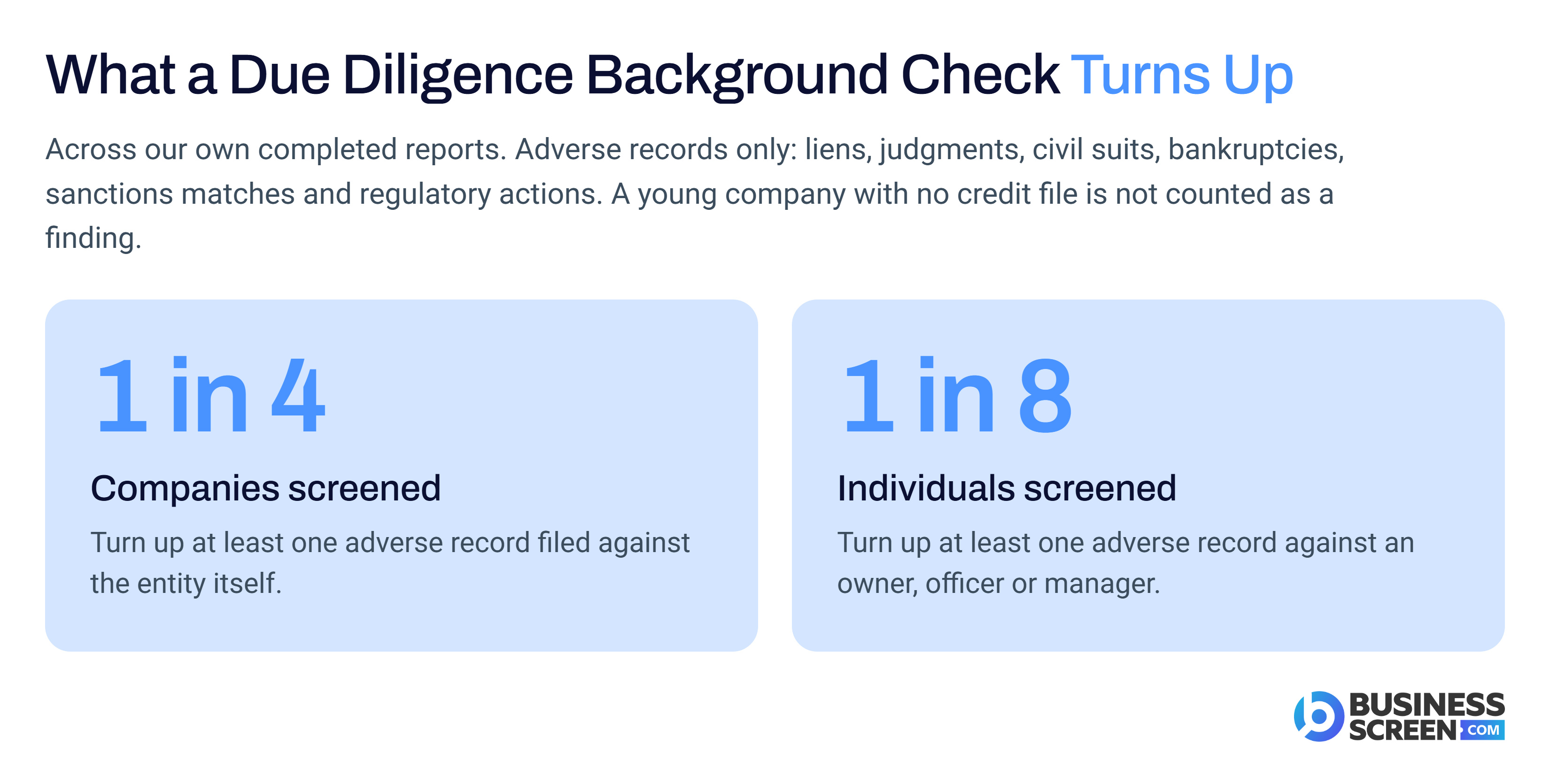
The raw flag rate is a good deal higher, closer to half of companies. We do not quote that number, because it counts things that are not findings. A company formed last year has no credit file, and a search that returns nothing is telling you the company is young rather than telling you anything is wrong. The one-in-four figure counts adverse records only.
Those ratios are the argument for screening broadly at a light depth rather than deeply on a select few. You cannot tell in advance which of the four it is, and the screen is inexpensive relative to the deal it protects.
The check runs against two subjects, and they answer different questions.
On the company, it establishes whether the entity exists as described and whether its record supports the claims being made. Is this a real registered business with the credentials and operating history it claims? Has it been subject to legal action, regulatory penalties, debarment or suspension? Is there financial strain in the form of liens, judgments or bankruptcy filings? Is it a shell arrangement with no evident operations? Identity and entity verification covers the first layer of that, and what KYB verification confirms and where it stops covers where a registration record runs out.
On the people, it asks a parallel set of questions about the owners, officers and key managers. Do they hold the experience and credentials claimed? Is there a litigation history that follows them across ventures? Have they been through prior business failures, regulatory actions or debarment? An entity formed two years ago has two years of record; the person who formed it may carry twenty, which is why a business background check should cover the principals too and why the operators are usually where the decision-relevant history sits.
The common way to investigate a counterparty is a one-size-fits-all data service. You enter a name and it returns everything it holds, which leaves you sorting and validating the output yourself.
Much of what comes back does not bear on the decision. Old property tax records, a traffic citation from a decade ago, hunting and fishing licences. Somewhere in that volume there may be a judgment that matters, and finding it is now your job rather than the provider's.
A private lending firm we work with came to us after their previous provider returned clear results on roughly 85 to 90% of borrowers. Their diligence lead, who came to lending from a foreclosure practice, knew that did not match the people they actually lend to.
“I expect every borrower that comes to us to have something, something somewhere. Whether it's property taxes that they owe or an old judgment that's been paid off but not cancelled. I expect to find something.”
So she began checking the clear results herself, against county real estate records and local court systems, and kept turning up what the reports had missed.
“We can't pay fifteen hundred dollars for a background check and have it come back clear, and then I spend three hours and find ten issues.”
The work worth paying for is the part after the search: confirming a record belongs to your subject rather than to someone with a similar name, retrieving the underlying document, and reporting what was found in language a decision-maker can act on. That gap between what a database returns and what an investigator confirms is the whole subject of database screening versus investigative due diligence. A sample report shows the difference between raw output and something you can put in front of a credit committee, and three findings that get misread covers what goes wrong when that step is skipped.
To open a check on a company we need the legal name, the address, and the names of the officers or principals, along with any identifying details you have for them. That is usually the whole list.
From there the depth is a judgment call about the deal rather than a fixed procedure. Knowing when to escalate a screen sets out the exposure test, and what a clean check can still miss is worth reading before treating an empty result as a clearance. If you want the mechanics of running one yourself, how to run a background check on a business walks through the sequence.
A due diligence background check answers a commercial question about a counterparty, using records a hiring check cannot reach, on a subject that has not consented and does not need to. What it examines depends on what would change your mind about the deal.
If you have a counterparty in front of you and are not sure what depth it warrants, that conversation is worth having before anything is ordered. Our investigators take those questions directly, including when the answer is that a lighter check is enough. We have been running diligence on businesses and the people behind them since 1996. Click the Get Started button below and fill out the form, and we will work through the counterparty with you.







.png)
